 Paul Rosser
Winter is officially here with 87.5mm for June, lifting our Year to Date to 155.5mm.
We had three reasonable falls of 11mm, 10mm &14mm with four between 5 & 10mm. It rained on 18 of the 30 days in June.
Compared to the last thirteen years:
2025 87.5mm 155.5mm (YTD)
2024 101.5mm 159.5mm
2023 156.0mm 327.5mm
2022 63.0mm 220.0mm
2021 80.5mm 200.5mm
2020 86.0mm 266.5mm
2019 74.5mm 192.5mm
2028 35.5mm 123.0mm
2017 26.0mm 196.0mm
2016 74.5mm 235.5mm
2015 17.0mm 212.0mm
2014 47.0mm 229.0mm
2013 98.0mm 227.0mm
2012 141.0mm 318.0mm
This was our second driest January to June figure since 2012.
Digging holes for native plantings the soil has been damp down to 150mm. It’s fair to say penetration has been fairly good so far but more is needed to get us through next summer.
For the next quarter:
- Rainfall is forecast to be average,
- Temperatures will be higher than average for both day & night time,
- Waters around Australia are cooling but still warmer than average,
- Stream flows are below average at this time as most of the rain has just soaked in & not run off,
- The Murray/Darling basin is at 60% & the Mt Lofty Ranges storages are at 36%, both down on last winter, at this time,
- All the oceans are around neutral; at this time.
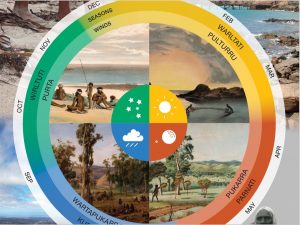
Our July marks the start of Kaurna Winter, which lasts until the end of September. Kudinthi is now taking place. This is the time for ‘washing the earth’, with strong winds accompanied by rain.
Our July marks the start of Kaurna Winter, which lasts until the end of September. Kudinthi is now taking place. This is the time for ‘washing the earth’, with strong winds accompanied by rain. Vegetable matter & grubs from the Sclerophyll scrub in the Mt Lofty Ranges are the main foods eaten. It is a time when ducks & water birds begin nesting. Their relationship with the earth continues to be strong.
It was good to see $150 million in the recent state budget for the environment. Also this week, the new Landmark Biodiversity Act was passed by Parliament. It is the blueprint which will:egetable matter & grubs from the Sclerophyll scrub in the Mt Lofty Ranges are the main foods eaten. It is a time when ducks & water birds begin nesting. Their relationship with the earth continues to be strong.
It was good to see $150 million in the recent state budget for the environment. Also this week, the new Landmark Biodiversity Act was passed by Parliament. It is the blueprint which will:
- Ensure our state’s biodiversity is protected,
- Safeguard our native vegetation,
- Create stronger penalties for those who destroy our natural environment,
- Create new processes to identify & safeguard habitats vital for the survival of threatened species,
- Provide for a new list of threatened species & communities which will be overseen by a special scientific committee,
- Raise the levels of penalties for offenders.
It was interesting to see the press release from the National Parks & Wildlife Service & Flinders University that pointed to the causes of the algal bloom along our coast. There are three plausible causes according to the release:
- The higher-than average temperatures around the coasts of Australia,
- The massive flush of nutrients from the recent River Murray Floods, &
- An unprecedented cold-water upwelling in the summer of 2023-24 that brought nutrient rich water to the surface around the coast.
Similar blooms that have happened around the world have lasted from a few weeks up to 18 months. All have disappeared naturally over time as conditions regained balance. We can however, expect more of these as Climate Change worsens. Hopefully, science will help us find a solution.
Catch you next month
Paul
About Author